
How much tile adhesive do I need?
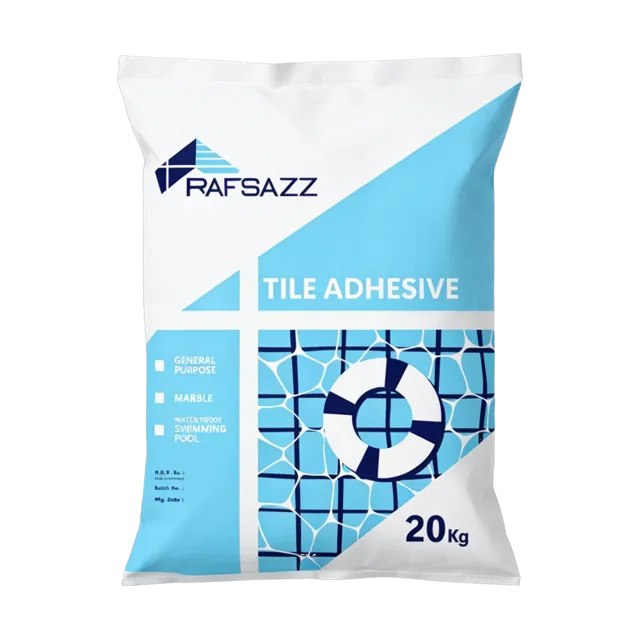
Buy too little and the job stops halfway; buy too much and money sits on the shelf. This guide shows you how to estimate tile adhesive accurately — by area, bed thickness and tile size — with worked examples for RAFSAZZ Tile Adhesive, and a free calculator that does the maths for you.
The short answer
Tile adhesive is sold and estimated by weight per square metre of coverage, and the single biggest factor is how thick a bed you trowel on. As a working rule for RAFSAZZ Tile Adhesive (C1TE) on a normal, reasonably flat surface:
- Thin-bed (3 mm) — standard wall and floor tiling — about 4.2 kg per m²
- Medium bed (6 mm) — large-format tiles — about 8.4 kg per m²
- Thick bed (10 mm) — uneven or out-of-level surfaces — about 14 kg per m²
These figures already assume a full, properly ridged bed. Multiply the rate by your area, add roughly 10% for wastage and cutting, then divide by 20 to get the number of 20 kg bags.
The formula
If you like to check it yourself:
Adhesive (kg) = Area (m²) × Bed thickness (mm) × 1.4 → then add ~10% wastage
The 1.4 is the coverage coefficient for a cement-based thin-bed adhesive. The thicker the bed, the more you use — which is why levelling the surface first, rather than burying the dips in adhesive, saves real money on a large job.
Worked example: a 100 m² floor
Say you are tiling a 100 m² floor with standard tiles at a 3 mm thin-bed:
- 100 m² × 3 mm × 1.4 = 420 kg
- Add 10% wastage → 462 kg
- 462 ÷ 20 = 24 bags of RAFSAZZ Tile Adhesive 20 kg
Step up to 6 mm for large-format tiles and the same floor needs about 47 bags; at a 10 mm thick bed on an uneven slab, around 78 bags. Bed thickness, not area, is usually what blows a budget.
What changes how much you use
- Tile size. Bigger tiles need a thicker notch trowel and often back-buttering, so a larger bed and more adhesive per m².
- Surface flatness. A wavy or out-of-level surface forces a thicker average bed. Levelling or plastering first (with RAFSAZZ Ready-Made Plaster) is cheaper than levelling with adhesive.
- Trowel notch size. A 6 mm notch lays far less than a 12 mm notch. Match the notch to the tile.
- Wastage. Cuts, corners, mixing losses and partial bags. We build ~10% into our calculator; tight or intricate layouts can run higher.
Let the calculator do it
Rather than work it out by hand, use the free RAFSAZZ Coverage Calculator. Pick Tile Adhesive, enter your area in m² or square feet, choose the bed thickness for your tile, and it returns the kilograms and the exact number of 20 kg bags — wastage already included.
Frequently asked questions
How many square metres does a 20 kg bag of tile adhesive cover?
How many bags do I need for 100 square metres?
Is tile adhesive better than cement and sand for fixing tiles?
Does RAFSAZZ Tile Adhesive work for vitrified and porcelain tiles?
The RAFSAZZ products mentioned above
More guides
C1TE vs C2TE: which tile adhesive for which tile?
Walk into the adhesive aisle and you will see codes like C1TE and C2TE. They are not marketing — they are the EN 12004 European classification that te…
Read guide →4 min readHow-toHow to apply wall putty, step by step
Wall putty is what gives a wall its smooth, hard, bright-white base before paint — and a good putty job makes cheaper paint look expensive, while a po…
Read guide →6 min read